stark incongruity of Pakistan’s elite-captured society was highlighted by two contrasting reports last week. While the planning ministry’s Household Integrated Economic Survey revealed that poverty had surged to a record high, separate news reports disclosed that the Punjab government has acquired  rate is the highest in these areas, which lack economic development.
According to the report more than 65pc of the population in Balochistan’s vulnerable districts inhabit temporary or makeshift homes; 50pc do not even have toilet facilities; and 40pc must do without proper water facilities. In these most vulnerable districts, people are deprived of easy access to roads, transport facilities and even phones. It’s different in Punjab, where there is much better access to these facilities, especially in the northern and central areas.
In the former Fata districts, the majority of the population lives below the poverty line. Prior to the merger of Fata into KP, the federal government had promised an annual release of Rs100 billion for a decade to spur development in the war-torn tribal region, bringing it at par with other parts of the country. But only a fraction of the promised funds has been released by the centre since the merger in 2018. Punjab and the two other provinces have refused to pay their share to that fund as was originally promised. The irony is that Punjab can reportedly spend Rs11 billion to acquire a VVIP jet but is not willing to contribute to the development of the war-ravaged regionThere is a strong correlation between poverty and militancy. It’s not a coincidence that the economically backward regions of KP and Balochistan are most affected by the ongoing insurgency. Deprived of basic economic and democratic rights people there are becoming increasingly alienated from the state. Unfortunately, the state has done nothing to address these issues, relying, instead, on brute force to deal with the problem. Against this backdrop, it is hardly surprising that the youth in large numbers are easy recruits for militant groups in Balochistan. More importantly, shrinking democratic space has made it extremely difficult for the people to get their economic rights. These vulnerable areas in KP and Balochistan are rich in minerals and the central government is hopeful about drawing foreign investors to the sector. But nothing is being done to improve the lives of the people. Discontent is turning matters volatile.
Growing regional disparities, denial of democratic and economic rights and the widening gap between the rich and poor have created a dangerous situation. Yet, the ruling elite doesn’t realise the gravity of the situation. The acquisition of an expensive jet for the Punjab CM in times of worsening poverty is just one aspect of an elite-dominated power structure.
The writer is an author and journa
is now moving into the extraction phase. However, its real challenge lies in the last two phases. Capturing value through industrialisation and ensuring socioeconomic transformation will determine whether Pakistan becomes a success story or a cautionary tale.
The writer is an analyst of South Asian affairs. The views express Third, mineral success depends heavily on security, stability and peace in the neighbourhood. We can take the two contrasting examples of Chile and Congo. Chile, despite having historical disputes with its neighbours, has enjoyed decades of peaceful borders without active conflict, which has enabled it to attract sustained foreign investment and emerge as the world’s leading copper producer. In contrast, the experience of the Democratic Republic of Congo demonstrates the opposite. The future of Pakistan’s minerals diplomacy will depend less on the size of the country’s reserves and more on Islamabad’s ability to ensure security and stability within its territory and in the neighbourhood. The smart management of conflicts with its neighbours and a peaceful environment will build investors’ confidence.
To conclude, minerals diplomacy has five phases, ie, resource identification; investment mobilisation; extraction; value chain capture and industrialisation; and lastly, socioeconomic transformation. Pakistan has successfully completed the first two phases of minerals diplomacy and is now moving into the extraction phase. However, its real challenge lies in the last two phases. Capturing value through industrialisation and ensuring socioeconomic transformation will determine whether Pakistan becomes a success story or a cautionary tale.
The writer is an analyst of South Asian affairs. The views expresseTHE dismantling of democratic structures and institutions within the past decade will likely take many more decades to recover from. During this time, we’ve already seen a muzzle on the press, a scalpel to the courts, and are now deliberating a wrecking ball for the Pakistani federation. The idea of carving the country into more provinces is neither new nor original, and yet it resurfaces like a political influenza every so often. Just recently, it has given us a sustained campaign by the Istehkam-i-Pakistan Party for 16 provinces, squabbles in the Sindh Assembly over a resolution against dividing Sindh, bickering between the PPP and PML-N over whose province should be bifurcated first, and wild rumours in Islamabad of what a potential 28th Amendment may look like.
People usually make this case for two reasons. One stems from a bottom-up demand for an ethnolinguistic group to be recognised, such as in South Punjab. The other is a top-down argument for efficiency that, in fact, cloaks a centralisation impulse within the language of decentralisation. The details may vary, but the broad idea is that the present structure is too top-heavy; that the provinces — sup
THE dismantling of democratic structures and institutions within the past decade will likely take many more decades to recover from. During this time, we’ve already seen a muzzle on the press, a scalpel to the courts, and are now deliberating a wrecking ball for the Pakistani federation. The idea of carving the country into more provinces is neither new nor original, and yet it resurfaces like a political influenza every so often. Just recently, it has given us a sustained campaign by the Istehkam-i-Pakistan Party for 16 provinces, squabbles in the Sindh Assembly over a resolution against dividing Sindh, bickering between the PPP and PML-N over whose province should be bifurcated first, and wild rumours in Islamabad of what a potential 28th Amendment may look like.
People usually make this case for two reasons. One stems from a bottom-up demand for an ethnolinguistic group to be recognised, such as in South Punjab. The other is a top-down argument for efficiency that, in fact, cloaks a centralisation impulse within the language of decentralisation. The details may vary, but the broad idea is that the present structure is too top-heavy; that the provinces — supposedly empowered after the 18th Amendment — are too unwieldy as units. Breaking free from such provincial capture is presented as the ultimate technocratic solution.
Home
Latest
T20 World Cup
Pakistan
Opinion
Business
Images
Prism
World
Sport
Breathe
Magazines
Tech
Videos
Popular
Archive
Flood Donations
Search
Search
Federation demolition
Danyal Adam Khan Published February 25, 2026 Updated about 4 hours ago
2
The writer is a governance specialist.
1x
1.2x
1.5x
comments
Whatsapp Channel
THE dismantling of democratic structures and institutions within the past decade will likely take many more decades to recover from. During this time, we’ve already seen a muzzle on the press, a scalpel to the courts, and are now deliberating a wrecking ball for the Pakistani federation. The idea of carving the country into more provinces is neither new nor original, and yet it resurfaces like a political influenza every so often. Just recently, it has given us a sustained campaign by the Istehkam-i-Pakistan Party for 16 provinces, squabbles in the Sindh Assembly over a resolution against dividing Sindh, bickering between the PPP and PML-N over whose province should be bifurcated first, and wild rumours in Islamabad of what a potential 28th Amendment may look like.
People usually make this case for two reasons. One stems from a bottom-up demand for an ethnolinguistic group to be recognised, such as in South Punjab. The other is a top-down argument for efficiency that, in fact, cloaks a centralisation impulse within the language of decentralisation. The details may vary, but the broad idea is that the present structure is too top-heavy; that the provinces — supposedly empowered after the 18th Amendment — are too unwieldy as units. Breaking free from such provincial capture is presented as the ultimate technocratic solution.
The diagnosis is correct. Pakistan is highly centralised at both the provincial and — as is conveniently ignored in such analyses — federal levels, where the 60 or so cabinet positions belie any claims of right-sizing. It is also an established fact that decentralisation produces better results for more people in more places, and that it requires far greater devolution to the grassroots than is currently the case. However, if devolution is really the aim; if more responsive, more accountable governance is really the goal, then there is a perfectly usable and proven mechanism available in the form of local governments (LGs).
Over multiple decades now, every serious analysis of Pakistan’s governance landscape has reached the same conclusion: it is impossible to establish grassroots democracy or improve service delivery without a third tier of government. In this, there is no conceivable gain to be had from extra provinces that cannot be had from politically, administratively and fiscally empowered LGs. Assuming no ulterior motives or intellectual dishonesty, why would proponents of decentralisation not be rallying for meaningful devolution to the third tier rather than dismembering the second?
LGs need to exist as a logical extension of the federal structure.
Besides the bureaucracy — which has long occupied the vacuum left behind by LGs — it is a historical fact that our political leadership has resisted meaningfully backing the third tier, viewing it as a threat instead of a democratic opportunity. It is still entirely within their burden of responsibilities to generate enough cross-party momentum to reach a consensus. This is, admittedly, a challenge in the current political climate; and yet somehow seems less of a challenge than the creation of new provinces.
Beyond the technical shallowness of this idea, it is also devoid of any political memory. It completely disregards the political symbolism of the province and what it means to those who call it home. This is not meant as sentimentalism; it’s a lesson in history that lawmakers would do well to remember before taking an axe to the structure of the country. As much as centralising forces have categorised this as a thought-crime, it remains true that Pakistan was envisioned as a state comprised of multiple nations. The ethnolinguistic boundaries of our provinces matter. Recognising, respecting and nourishing them makes the federation stronger, not weaker.
Provinces are also the bulwark of political resistance. This is why dictators love bypassing them. This is also why, as any student of history knows, LGs have flourished during times of dictatorship, and have long been used to create an illusion of decentralisation, while circumventing the provincial tier and its political leadership. It falls to the guardians of Pakistan’s democratic structure to preserve the integrity of the second tier and take ownership of the third. In other words, LGs need to exist not as a replacement of the federal structure, but as a logical extension of it.
Political temperatures in this country are already soaring — especially at the peripheries of KP and Balochistan — and any tinkering with the federal structure will inevitably be seen as another power grab by the centre. The delicate balance of this federation has been built on hard-won battles and bitter lessons. It would be a waste for the architects of the 18th Amendment and the Charter of Democracy to throw it all away for short-term political gain.
The writer is a governance specialist.
Published in Dawn, February 25th, 2026



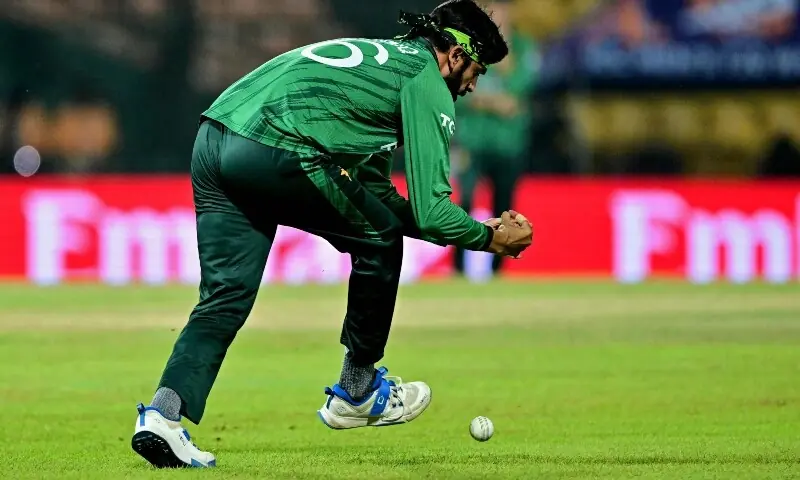
 Pakistan’s Tariq Usman (R) drops a catch of England’s Jacob Bethell during the 2026 ICC Men’s T20 Cricket World Cup Super Eights match between England and Pakistan at the Pallekele International Cricket Stadium in Kandy on February 24, 2026. — AFP